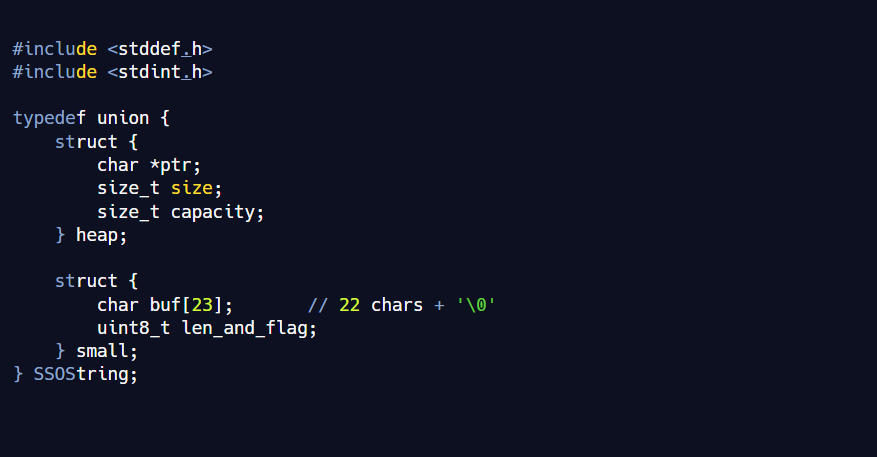
A std::string in LLVM's libc++ can hold up to 22 characters without allocating any…
This is a dev post classified by AGK Intelligence as Languages & runtimes (a tutorial), kept by the Dev Radar because it carries real work, not commentary.
A std::string in LLVM's libc++ can hold up to 22 characters without allocating any memory on the heap. The entire string object is just 24 bytes on common 64-bit systems. For longer strings, those same bytes store a pointer, length, and capacity instead. the trick is small string optimization (SSO): a union that lets the string reuse the same memory for two completely different representations. On a typical 64-bit system, both representations fit in 24 bytes. the string doesn't need a separate allocation until it outgrows its own object.
Posted by Arika (9k followers) 23 h ago · 268 likes · 14.4k views · view the original post on X. Kept by the Dev Radar as Languages & runtimes.
More dev work like this
- Roundhouse turns Rails apps into standalone binaries or services in Rust, Swift,… — @rustaceans_rs
- We're starting work on Pydantic V3. — @pydantic
- zuvloop: a drop-in asyncio event loop, powered by libuv and written in Zig ⚡ — @marcelotryle
- Small Crates Behind Big Rust Systems — @rustaceans_rs
- js tip. infinity — @xah_lee
- massive tech geeking on javascript. — @xah_lee
- Infinity is a lightweight Rust framework for massively concurrent agents—75k fit on a… — @rustaceans_rs
- Need synchronous work NOW, but your C++ API expects a std::future? 🧠⚡ — @VisualStudio
Every post is read and classified by AGK Intelligence: what it is, which market it belongs to, and whether the link is a real tool. 31.2k posts from 5k X accounts over the last 21 days, 8.8k tools, 12 markets. New posts are collected several times an hour and the full ranking is recomputed every hour — last update 2026-10-30 20:27 UTC. Full method.